ANZACS
PRIVATE ROSS ROY COCKMAN: 4580
The grandson of the earliest settlers to the area known as Wanneroo, Ross was the youngest boy in his family, the 12th of 13 children. His father lived all his life in the original Cockman homestead in Wanneroo. Ross had, for most of his life, lived his life in the footsteps of the older boys; he had the same occupation, he attended the same school, picnics and family occasions every year, he wore hand me downs from his older brothers. There were seven of them, so there was no shortage.
World War 1 offered Ross excitement and adventure, and a chance to see the world away from the market garden. He was the first in his family to sign up, just minutes before William an older brother.
Four of the eight Cockman boys volunteered, Ross, William, Ernest and Wesley.
From 6 August 1915, he spent the next 10 days with his family before reporting to Blackboy Hill training camp on 16 August 1915.
On 11 January 1916, Ross sent a postcard to his sister-in-law from camp, saying “Tell Jack we are having a big march through Perth Saturday to come in & see it.”
Private Ross Cockman joined the 16th Infantry, 14th Reinforcements. There were 208 men from all walks of life, including 173 single men, one politician, 49 labourers, 15 miners, and 18 who were farmers or gardeners, Private Ross Cockman was one of these.
This great mixture of men embarked at Fremantle, Western Australia, on the
H.M.A.T. A 28 ‘Miltiades’ on 12 February 1916.
Ross and his brother William travelled together on the ‘Miltiades’ on 11 March 1916.
They disembarked at Port Suez., Those of rank had their photo taken.
On 2 April 1916, he was taken on strength in the 48th Battalion, but on 19 April, he
was transferred to the 51st. On 5 June 1916, he proceeded to join his unit at
Alexandria on the ‘Invernia’ For those who were not terribly seasick, training
continued. Private Monk was court-marshalled for climbing the ships mast, he was a
small monkey! They disembarked at Marseilles on 12 June, and were then
crowded into cattle trucks on a train bound for Abbeville. “The men on the train who
could see through the gaps in the trucks enjoyed the scenery”
On 19 June, his unit was on the move from south of Moolenacker. He was still with
his brother William, who was also with the 51st. Marching in full uniform and
carrying the day’s food ration, a blanket and plastic sheet, they were divided into two
groups and marched by different routes to Sailly.
On 22 June 1916, stretcher bearers were assigned from the 51st and kept aside.
The 51st were in the field, near Mouquet Farm, when Ross was wounded in action
on 17 August 1916, suffering from shell shock. After the move to Sailly and to
Mouquet Farm, the 51st Battalion was depleted; 302 men had been killed, wounded
or were missing.
On 28 September 1916, Private Cockman was discharged from hospital. While in
hospital, his brother William was reported missing. Word later arrived that his
brother had died, it must have been doubly hard for Ross, as he was not there on
September 3rd to either help William or see him before burial.
During this time, his parents were desperate for news, each time they asked they
received the same complicated answer that meant, If we hear anything we will tell
you, if you don’t hear, everything is alright.
Leaving hospital, Ross was sent for training to the Machine Gunners school, then
assigned to the Number 13 Machine Gun Company on 3 November 1916.The war
diary kept by the Company Captain states that 10 reinforcements arrived that day.
Private Cockman was one of them.
For the remainder of 1916, there was fighting, route marches, training, cleaning
equipment and some rest with bathing parades, whale oil for the feet, and Church
Parades. Most activity took place at Flers in the district of Somme.
In early 1917, the diary records that enemy planes were overhead, if they came low
enough they were fired upon.
On 28 September 1917, while at Belgian Chateau, Private Cockman was sick and
sent to hospital. His record states PUO; most likely Trench Fever. He was
discharged from hospital 15 October 1917 and joined his unit in the field at Peronne
on 10 December 1917. The following day, the men voted in the referendum to
accept or reject conscription.
On 15 December 1917, he received leave to go to England until 25 December 1917.
Returning to his unit in the field on 29 December, and to more training at Moislains.
Between 11 January and when they were stood down on 25 January, they were
busy fighting the enemy near Chateau Farm, thousands of rounds of ammunition
were used.
By 7 February 1918, they were back in the front line. On 26 February, Private
Cockman was one of 7 men wounded in action by gas poisoning, and on 2 March
1918 he was transferred to Hospital in Northampton, later to the 3rd Auxiliary
Hospital, Dartford
On 31 May, the Medical Officer cleared him to return to his company, he proceeded
to France from Grantham on 18 June 1918. He joined his new unit, which was now
the 4th Machine Gun Battalion, in the field on 23 June, in what was called the Hamel
Offensive.
On 10 October 1918, the 4th Machine Gun Company played football against the
13th.
At the beginning of January 1919, the Company was in Belgium.
On 20 January 1919, Private Ross Cockman was stretchered off the field, gassed
and his arm was burnt (2nd occurrence). He was subsequently sent to England for
treatment.
On 28 February, Private Cockman boarded the ‘Anchises’ bound for Australia, and
disembarked in Albany on 7 April 1919.
The people of Wanneroo put on a dance to welcome Ross and Wesley Cockman
home. The West Australian reported, ‘The chairman … presented to the district a
life-sized photograph of two of "our boys" who made the supreme sacrifice in France
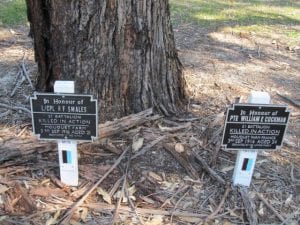
- Richard F. Smales and William E. Cockman”. These 2 young men now share a memorial tree in Kings Park

After his discharge, Ross married Ruth Berthfield Gibbs in 1925. They had 2
children, Kelvin and Beryl, before Ruth died on 29 June 1929. Ross did not remarry,
but cared for the 2 small children by himself while working as a road construction
worker, mostly on the Wanneroo Road. Family members who remembered him
have said that he was a wonderful father, and they were not sure how he managed
by himself.
In May 1942, he enlisted in WW2 aged 45, this time in the Air Force as ground
crew. His experiences in WW1 did not put him “off” once more doing his bit.
In June 1950, he published an expression of thanks in ‘The West Australian’ to all
who helped in the rescue of his grandson, John, aged 18 months, who had fallen
down a shaft near his home. Fortunately, he became stuck and was rescued by the
combined efforts of many people six hours later.
Ross Roy Cockman died on 5 February 1972, the same day I married. Three of
our grandchildren, Luke, Byron & Olivia Cockman, are the great-great-grandchildren
of Private Ross Roy Cockman, WW1. An adventurous life well lived.
At the library
I know the great value of the library, although I have not been to the local library since we moved home a year ago, but while studying for Families at War, a subject of the family history course offered by UTAS, I spent a lot of time at the family history part of the Wanneroo library. Where I was given access to photos that had not been sorted but placed in storage to be looked at at a later date .
I borrowed Many books about the 1st world war and sat and read articles that could not be removed from the library.
It was in the library that I read the sad stories about the great great great grandfather of 3 of our grandchildren.


Comments
Post a Comment